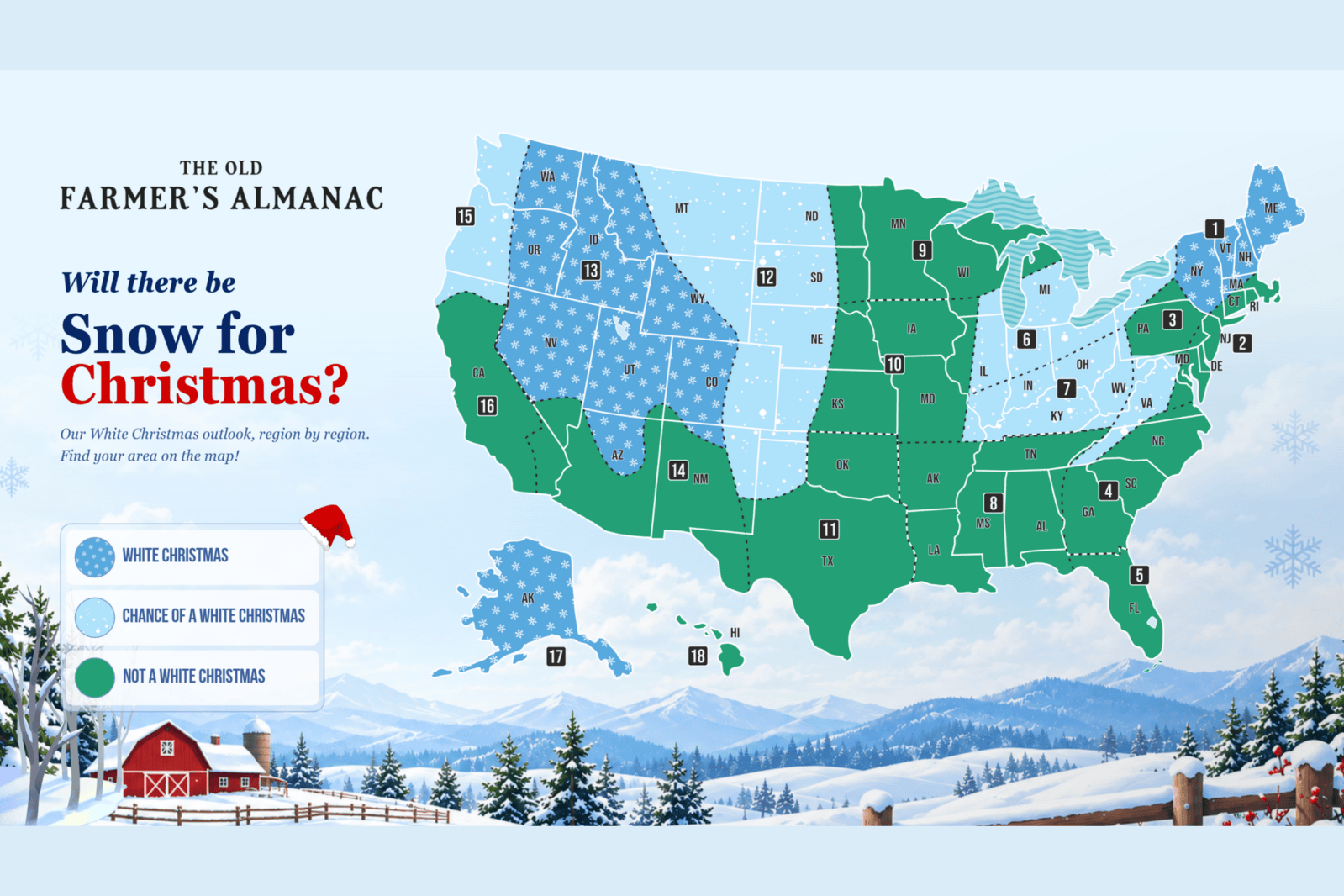
Many Americans wish for snow-covered landscapes on Christmas morning. The Old Farmer’s Almanac has forecasted the best opportunities for this seasonal phenomenon in 2026, specifically in the Northeast, the Intermountain region, and Alaska. While areas like the Pacific Northwest, High Plains, Lower Lakes, and Ohio Valley have potential for snowy Christmas, regions stretching across the South and central United States show negligible likelihood. These areas include the Atlantic Corridor, Southeast, Florida, Deep South, Upper Midwest, Heartland, Texas-Oklahoma, Desert Southwest, Pacific Southwest, and Hawaii.
In the Appalachian region, snow predictions vary. Northern parts are unlikely to see a white Christmas, contrasting with the southern areas where snow could potentially linger.
A “white Christmas” doesn’t demand snow on December 25 itself. The National Weather Service (NWS) defines it by having at least an inch of snow on the ground by 7 am local time that day. Snowfall occurring earlier can achieve this.
Reasons for Regional Variations
Higher chances of a white Christmas correspond with regions expecting above-normal snowfall this winter. This includes areas like the Northeast, Appalachians, certain western parts of the U.S., the Intermountain region, and Alaska. For instance, the southern Northeast anticipates noteworthy snowfall in mid to late December. This timing heightens the possibility of snow persistence through Christmas. Conversely, northern Northeast areas face a below-average winter snowfall, lessening chances for snow retention.
Western regions, such as the Intermountain area and Pacific Northwest, may also witness increased snowfall, although only the Intermountain area has a definitive white Christmas prediction.
According to Carol Connare, editor-in-chief of The Old Farmer’s Almanac, while much of the U.S. anticipates mild winter, certain areas will still experience substantial cold and snow.
Understanding The Old Farmer’s Almanac
Since 1792, The Old Farmer’s Almanac has provided long-term weather forecasts to aid farmers and gardeners. It uses a mixture of solar science, climatology, and meteorology, reviewing historical data, current solar activity, climate statistics, and extensive climate signals.
Meanwhile, the NWS’s Climate Prediction Center (CPC) offers formal U.S. long-term climate projections, detailing probabilities for temperature and precipitation changes.
The Almanac’s white Christmas prediction is an early indication, not a precise account of conditions on Christmas morning. Detailed forecasts closer to the holiday will deliver clearer expectations.
Historical Data Insights
The Almanac’s forecast aligns with historical regions inclined to have snowy Christmases. NOAA historical data identifies that Minnesota, Maine, upstate New York, Idaho, and various mountain regions frequently meet snow criteria on Christmas morning. Alaska almost consistently experiences a white Christmas.
Despite these trends, experts emphasize that historical data is primarily a guideline. Snow presence can fluctuate yearly based on conditions prior to Christmas. The Almanac similarly notes that long-term forecasts categorize weather trends instead of definitive daily predictions.
This outlook remains subject to change as the holiday approaches.
Leave a Reply